

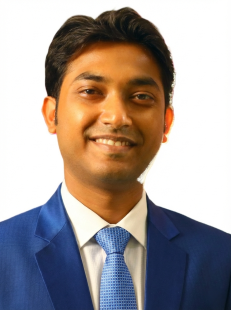
Subhajit Banerjee, Program Manager for AI at Forus Health
Imagine a baby weighing barely a kilogram. She cannot tell anyone something is wrong with her eyes, and her parents have no way of knowing what is happening inside them. Nearly one in three premature infants can be affected by some form of Retinopathy of Prematurity (ROP). Most cases resolve on their own, but the aggressive ones cannot wait. Left untreated, such cases can progress within days and lead to an infant losing sight permanently.

I find it heartbreaking to imagine a child growing up blind, because this is a blindness we know how to prevent.
When we talk about this, there is one question that people often ask.
“If you know it is preventable, why don’t you screen all premature babies?”
Certainly not for the lack of intent. Governments worldwide take ROP seriously and India’s own RBSK guidelines recommend screening for infants who meet criteria such as low birthweight. The constraints are people and infrastructure. India has an estimated 35 lakh preterm births every year, with each child ideally needing multiple follow-ups, while there are only a few hundred specialists in the country who can treat ROP. Also, screening has traditionally been done by hand, using indirect ophthalmoscopy. So screening, diagnosis and treatment all depend on a small group of specialists. With these constraints, serving care to the required scale is just not feasible.
Solving it in layers
A problem of this size rarely has a single answer, so we are working at three levels. Affordable neonatal cameras, such as the 3nethra neo and 3nethra neo HD FA, allows image acquisition to be decoupled from diagnosis. FH-TeleCare, our tele-ophthalmology platform, further helps to decentralize diagnostic expertise and improve outreach. Finally, our FH-POISE ROP-AI helps the experts review cases at scale. So, AI is not the “silver bullet” but just one proverbial “piece of the puzzle”.
Characterizing ROP, not just detecting it
Assessing ROP is not a yes-or-no question. Clinicians weigh severity (stage), location (zone) and plus or pre-plus disease together, in line with the International Classification of ROP (ICROP), before deciding on follow-up or treatment. We designed our AI to offer that same characterization.
It uses a patent-pending, attention-based transformer architecture that looks at all the images from a visit together, much as a specialist mentally maps the whole retina from multiple views. Models like this are usually heavy and cloud based. My team optimized ours to run completely offline on a general-purpose computer, with no GPU or internet connection. I am proud of what they achieved.
In retrospective validation, the system showed approximately 90% sensitivity and 95% specificity for detecting any ROP, with prospective validation ongoing. Having already obtained a CDSCO test license, we’ve begun deploying at sites across India for it.
We built the system to fit existing workflows rather than ask clinicians to change theirs. When a screening ends, the operator, who may not be a specialist, receives a first-pass indication, along with a heatmap and report to support counselling. Urgent cases can be flagged immediately for prompt specialist review. A relevance score sorts the images, so clinicians can pick the most informative ones for a report without sifting through the whole session. On FH-TeleCare, the same system can silently triage uploaded cases, so specialists see a prioritized list the moment they log in.
Helping at the point of capture
Even the best camera cannot guarantee a good image. Picture the operator: a fragile, crying infant in one hand, a device to manoeuvre with the other. It is natural to feel rushed and miss something important. The reviewing specialist is then left wanting clearer images. A second AI system, now in advanced development, is designed to guide operators in real time, so critical cases don’t slip through for lack of proper photo-documentation.
Why we build it this way
Had we been an AI-only company, we might have built just the characterization system, which is more research-oriented and headline-worthy. With about 820 installations globally, the 3nethra neo family has reached over 60 countries over the last decade and that exposure taught us what clinicians need every day. Features like relevance sorting won’t make headlines, but they make their work faster.
India is making a growing contribution to AI-driven medical imaging. For us, the goal is not just delivering advanced technology and products but the eradication of preventable blindness. It comes with great responsibility when it’s about delicate fragile eyes of new born babies.