

In the world racing towards fast fashion and rapid consumption, true design still emerges from something timeless – culture. At JD School of Design, powered by JD Institute of Fashion Technology, this notion is not merely a concept but a triumphant experience that is part of each classroom, studio session, and the student’s journey.
Indian crafts, among the world’s richest cultural legacies, are the core of design education at JD School of Design. However, the craft-based heritage of India is not viewed here as a romanticised past, but as a living, evolving source with the power to shape the future of fashion.


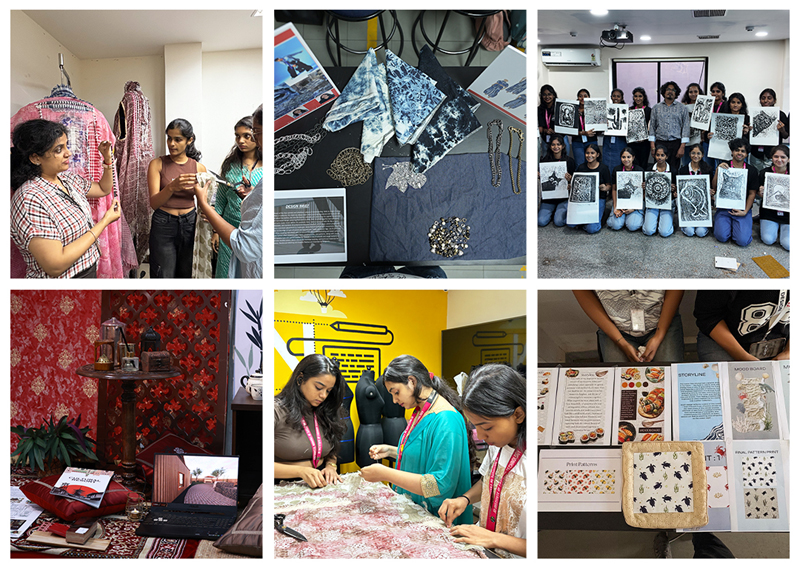
Walk into any JD campus, and you will come across a rhythmic sound that is quite typical of the place — the sound of wooden blocks hitting fabric, the aroma of natural dyes being prepared, the glint of zardozi threads reflecting light. These are not the workshops that are rarely conducted or the events that are off the schedule, but are the everyday learning experiences that have been deeply embedded in the curriculum. So students don’t simply gain knowledge of the crafts; they acquire knowledge by means of craft.
Craft as a Living Language
Indian artisans have, for generations, maintained and handed down the heritage of block printing, ajrakh, natural dyeing, intricate handloom weaving, and zardozi embroidery. At JD, students are not dealing with crafts as mere techniques, but as tales. Every motif, every dye, every stitch sings the history of community, of geography, and of identity.
Students get to understand craft as a living, breathing language that is capable of being adapted, interpreted, and innovated. In design studios, along with exploring digital tools or contemporary silhouettes, they also experiment with heritage crafts. The goal is to make them realise that craft is not a lifeless thing — it is growing if the coming generation takes it up courageously.
Where Ancient Skills Meet Modern Thinking
What is the difference between JD and others is the point of view that innovation and tradition are not antagonists; they are collaborators.
One of the students might use the handloom fabric and pair it with a pattern made for a futuristic concept. Another student may re-interpret streetwear with ajrakh motifs. A third student may experiment with natural dyeing but decide to use it for performance fabrics of the modern era. The students do not push these mergers; the students just naturally do these fusions when they regard craft as a thing that is not fixed – something that can move through time, aesthetics and market needs.
With resources such as worldwide trend forecasts, cutting-edge textile labs, industry collaborations, and lucrative workshops with master artisans, JD students find themselves at the intersection of heritage and forward-thinking design. They come to know that the future of the fashion industry is not about cutting off one’s roots, but rather branching them out further.
A Culture That Values Both Skill and Story
Craft education at JD, besides being an exercise of the technique, is a matter of responsibility as well. Each time a student discovers the skill of block printing or zardozi, he or she also learns about the artisans who have been holding these traditions firmly through the ages of wars, migrations, economic fallout, and changing tastes. Every project becomes an opportunity to delve into the ecological wisdom behind natural dyes or the cultural symbols behind the traditional motifs.
This knowledge moulds the designers who, apart from making stunning garments, are also considerate of the ecosystem that is the source of their works. Sustainability thus becomes a habitual practice, rather than a style, and cultural sensitivity becomes an innate feature of personality, not a learnt behaviour.
Reimagining Craft for a New Generation
It is the students’ work most of all that has undergone a profound change, in which the designs seem not only to be deeply Indian but also captivatingly modern. All of a sudden, a heritage weave can be transformed into a trendy jacket. A print that has been around for ages can be turned into a chic co-ord set ready for the runway. A craft cluster can turn into a flourishing design collaboration.
JD neither keeps Indian crafts as silent exhibits in museums nor confines them to textbooks. Rather, it imparts to them the motion, the importance, the visibility — a contemporary voice. And, through this, students realise that their heritage is not merely an object of retrospection, but something that they are able to carry forward with them.
Crafting Tomorrow, Rooted in Today
The design journey at JD School of Design is, actually, a journey back to one’s roots and forth into one’s future — all these being intertwined. When students bring tradition into line with innovation, they do not stop at fabricating garments; they bring about cultural continuity.
Here, heritage is neither a chapter nor an item, but a dialogue — a conversation that each designer keeps on having with his/her hands, creativity, and heart.