


There is a version of this story where the Indian legal system works on merit. Where the best researcher gets the internship, the sharpest drafter gets the job, and the most prepared student wins the brief. That version of the story is not true.
The version that is true: roughly 1.5 lakh law students graduate in India every year. The same five colleges produce the bulk of Tier-1 hires. The filter is not a skills test. It is a geography of privilege — which college you got into at seventeen, whose child you are, who your professor can call.


The information that changes outcomes — which firms are hiring, how they actually recruit, what a winning application looks like, which questions are on the AIBE — has always been a private asset. Passed between the right people. Kept away from the rest.
What We Decided To Do About It
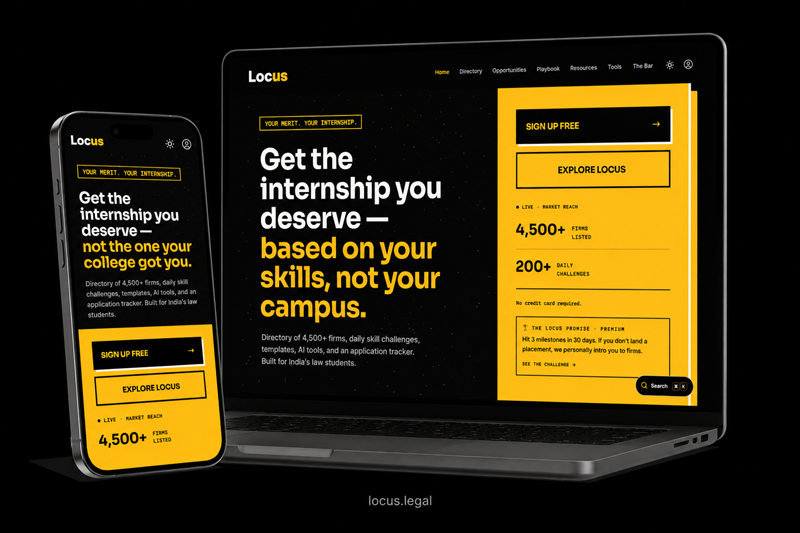
We indexed over 4,500 firms and made the directory searchable and free. We built a skill-testing platform where the leaderboard shows your score, not your college. We built a vacancy board with human-verified listings for the students whose colleges do not have a placement cell. We built the tools — CV analyser, cold-email playbook, legal document generators — that no coaching centre was going to give away for free.
We did not build Locus legal to romanticise the legal profession. We built it because the distribution problem was solvable and nobody was solving it.
What We Are Not
We are not a placement agency. We do not take a cut. We are not a coaching centre. We do not have a premium tier hiding the useful things. We are not a directory that gets sold to recruiters. The platform is built for students, and it stays that way.
The Indian legal industry runs on pedigree. Locus is what happens when that stops being the only option.
Free. Auditable. Built by lawyers who failed first.